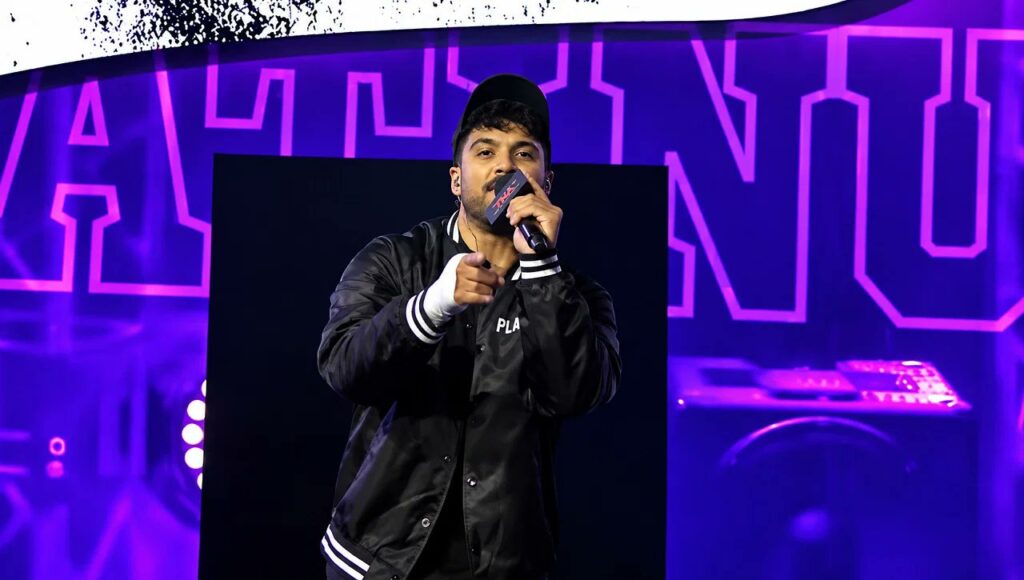

The Stunner has launched a new series, Wiki Fact Check, hosted by Graham Hartmann. Anyone who followed Hartmann’s long-running Wikipedia: Fact or Fiction segment at Loudwire will recognize the format: he pulls up a guest’s Wikipedia page, reads the claims back to them, and lets them sort out what is true, what is false, and what some editor got hilariously wrong. This is the spiritual successor, now aimed squarely at the wrestling world.
For the debut, Hartmann sat down with the legendary Matt Hardy at ACW Mischief Night 2 to run through his page. The full episode is above. Here is how Hardy did against his own Wikipedia.
The Basics: Name and Hometown
Hartmann started simple. The page lists him as Matthew Moore Hardy, born in Cameron, North Carolina. The name: true. The hometown: close, but not quite. “That is true, but I was technically born in Sanford, North Carolina,” Hardy said. So the name checks out, the state checks out, and Wikipedia gets dinged on the city.
The Old Ring Names
Hartmann next read off a list of Hardy’s past personas. Damascus? “True.” High Voltage? “True.” The Raw Reaper? “That is true, I did do that.” Surge? “Yes.” The one Wikipedia botched was “Ingus Jinx,” a mangling of the real thing. “They got the name wrong,” Hardy explained. He was actually Ignis Fatuus, a Will-o’-the-Wisp-style character meant to complement Jeff’s “Willow,” though the TV announcers butchered both names on the air.
And The Wolverine? False. “No, that is Jeff,” Hardy said. “This is why we have to go through this stuff.”
Childhood Friends With The Hurricane
Wikipedia says Hardy was childhood friends with Gregory Helms, better known as The Hurricane. True. “We met just through our love of wrestling, because we were just starting to break out on the indie scene as teenagers,” Hardy said. Helms later worked for Hardy’s Omega promotion and even ran it for a stretch. “There was a time where I was away and he actually took Omega for a while and ran shows, like in 2012, 2013, 2014.”
The Engineering Degree
The page claims Hardy attended the University of North Carolina and majored in engineering. Mostly true. “It was the University of North Carolina at Charlotte,” he clarified, adding that he is “a big UNCC fan generally just because of Michael Jordan.” He was studying civil engineering and actually earned his associate degree before wrestling took over. “I decided to become a college dropout and pursue pro wrestling. And I guess it half-ass worked.”
He Sewed Everything Himself
Here is a great one. Wikipedia says Hardy sewed all the costumes he and Jeff wore in Omega. True, and it goes further than the page even says. “I sewed all of the tights we wore. All the tights that you saw us wear on WBTV in the 90s, I sewed all of those as well,” Hardy said. Even the plaid. The backstory is genuinely moving: “Our mom had died when we were younger. I dusted off her old sewing machine and taught myself how to sew, and then I’d start making our tights.”
The Stolen High Voltage Name
This is the wildest entry on the whole page. The story goes that Hardy sent a tape to WCW’s amateur challenge under the name High Voltage, WCW then debuted a tag team called High Voltage, and years later Chris Kanyon told Hardy the tape had been kept at the WCW Power Plant, watched repeatedly, and the name flat-out stolen. True. “That is a mad fact. That’s very true,” Hardy confirmed. Seeing another team use his name stung enough that, as he put it, “that’s why I actually changed my name from High Voltage to Surge.”
The WWF Debut (and the Night After)
Hardy’s first WWF match was against Nikolai Volkoff on Monday Night Raw, live on TV. True. He remembers the nerves vividly. Agent Tony Garea warned him, “If you mess up in this match, you’ll never wrestle for WWE again,” while Volkoff kindly offered to take big bumps to make the rookie look good. “I already thought, okay, great, I’m never going to come back again. It’s going to be a one-and-done run.”
Wikipedia then claims he wrestled Owen Hart the next night. False. “The very next night I wrestled Scott Hall,” Hardy corrected. He had a great story to go with it: Hall, a last-minute substitution, told Hardy to feed him chops, and Hardy hit two so loud that Kevin Nash ribbed Hall afterward. “Kevin Nash, when he came back through, said, I can’t believe this guy showed you up.”
Training With Dory Funk Jr.
After the brothers signed full-time in 1998, the page says they were sent to train with Dory Funk Jr. at the Funking Dojo. True. “You only truly learn in this industry if you work with people that are better than you,” Hardy said. Funk taught them terminology and “the psychology, especially of storytelling within the context of a match,” plus when to change gears and lean into the violence.
The 2001 Split That Wasn’t
Wikipedia claims that at the end of 2001, the brothers began fighting with no actual storyline behind it, then were quietly put back together and it was never mentioned again. Hardy says the page oversimplifies it. “There was a storyline for our characters, and they wanted us to split up,” he said. There were “a couple things that we were asked to do,” Jeff was uncomfortable with one of them, and the two were pulled off TV as a de facto punishment before being reunited because they knew they were not ready to split. As for what Jeff refused to do? “Nothing I can say on here, because I would like to stay married.”
Where “Delete” Really Came From
One for the lore hunters: the page credits Hardy’s “Delete” taunt to the Death Note character Teru Mikami. False. “Delete was a very trendy word, it was cool in pop culture at that time,” Hardy said. The taunt was actually born during the Final Deletion, when he was shooting fireworks at Jeff. “I would shoot a firework and go delete, delete, delete, delete. And I noticed it started catching on.” He turned it into a finger-swipe gesture, “just like how you do on a phone.” Hartmann admitted he always figured it came from Doctor Who, and Hardy said he has heard that theory too.
Billy Corgan and the Broken Gimmick
The page credits Billy Corgan with inventing the Broken gimmick. Partly true. Corgan supplied the spark, not the character. “He said, what if you guys fought like all over your compound?” Hardy recalled, which is where the Final Deletion concept began. The character itself was all Hardy: “something I came up with after my wife and I just binge-watched True Blood,” he said, pulling pieces from Dexter, True Detective, and, memorably, the creepy British YouTube cartoon Salad Fingers.
Full Creative Control in TNA?
The last claim: that Hardy had full creative control over the Broken gimmick in TNA. “That’s not fully correct,” he said. He worked closely with Jeremy Borash and had heavy input from home, but not total control. He was reportedly close to earning near-complete control, until a falling-out over money, plus Jeff Jarrett arriving during a rough stretch, sent the brothers back to WWE. “If I would have stayed, I would have probably had almost complete creative control. I’d been very close to it.”
That is the first-ever Wiki Fact Check in the books, and Matt Hardy passed with flying colors, even if his Wikipedia page did not. The Stunner thanks Hardy for his time at ACW Mischief Night 2. And whatever you do, do not delete this footage.