
The holiday season is officially underway. So it’s time for the time-honored tradition for wrestling fans everywhere, when we gather ‘round the fire to listen to デストロイヤーの楽しいクリスマス (Desutoroiyā no tanoshī kurisumasu) or, Destroyer’s Exciting Christmas.
What? You don’t know about Destoyer’s Exciting Christmas?
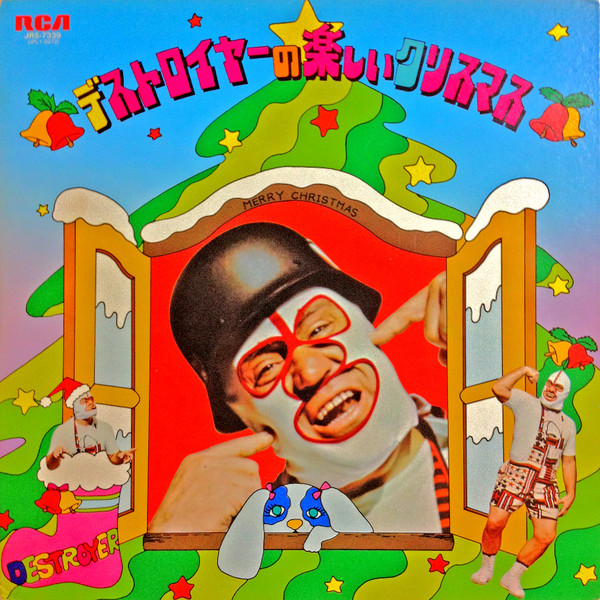
First off, look at that album cover. The vivid psychedelic colors, the wavy lines on the Christmas tree, the absolute lack of context of what the hell this is. Anyone outside of Japan in 1974 would have no idea why a man is wearing a loose-fitting mask under a German WWII helmet, along with a pair of single-strap multicolored shortalls.
Playing the record offers no immediate explanation. After a bit of Taiko drums, a gruff middle-aged man begins to sing “Jingle Bells,” dipping back and forth from English to Japanese.
It’s not until the second song that the voice introduces our singer: “Ladies and Gentlemen, The Destroyer!” And what does he sing? A heartfelt rendition of “I’m Dreaming of a White Christmas” entirely in English. And here’s a woman singing along. Spoiler alert: it was his then-wife, Mrs. Destroyer!
We then get our first “skit” with The Destroyer telling us it’s Christmas time and that the kids are sleeping (that’s as much as Google Translate could translate). After “Santa Claus is Coming To Town,” Destroyer delivers a rendition of “I Saw Mommy Kissing Santa Claus” in Japanese (with what one assumes is a pitched-up version of his voice singing in English).
At this point in the record, a common question arises: how did this happen? That, and who is The Destroyer?
WHO WAS THE INTELLIGENT, SENSATIONAL DESTROYER?
The Destroyer was born Richard Beyer in Buffalo, New York, in 1930. After developing his football and amateur wrestling skills at Syracuse University, Beyer trained with Dick Hutton and Al Haft before making his pro-wrestling debut in 1954 as “Schoolboy” Dick Beyer. In 1962, when wrestling for Jules Strongbow’s World Wrestling Alliance in Los Angeles, Beyer donned a mask, becoming The Destroyer (or, as he demanded to be called, “The Intelligent, Sensational Destroyer”).
The Destroyer became an instant attraction. He battled legends of the ring like Rikidozan, Lou Thez, Giant Baba, and Gorgeous George (whom The Destroyer inducted into the WWE Hall of Fame in 2010). Beyer’s friendship with Rikidozan and the 6’11, 330-pound Baba led to The Destroyer working in Japan—first for Rikidozan’s Japan Pro Wrestling Alliance in the 1960s, and then for Baba’s new promotion, All Japan Pro Wrestling, in 1972.
HOW DID THE DESTROYER END UP ON JAPANESE TV?
According to Beyer’s 2011 memoir, Masked Decisions, he devised a plan to help score some extra publicity for All Japan. When responding to the deluge of letters from Japanese fans, Beyer encouraged his followers to call All Japan’s broadcaster, NTV, to request to see The Destroyer on other types of television programs.”
Beyer figured he would get on one or two shows and hype up AJPW. But the fan response was so overwhelming that he ended up on “a noontime cooking show, a game show, and other programming where, in limited Japanese, he drummed up interest for Saturday night wrestling on television and Baba’s arena shows.”
As All Japan grew in popularity, so did The Destroyer. NTV realized that fans wanted to see The Destroyer outside of the ring as much as inside it, so they cast Beyer on Uwasa No Channel, an hour-long comedy/music variety program.
Beyer acted in skits, language barrier be damned; he memorized his Japanese lines phonetically, and his rudimentary pronunciation endeared him to viewers. By December 1973, Uwasa No Channel was the most popular show in Japan, and The Destroyer—who now sported a German military helmet over his mask—was a star.
A NIGHT OUT LED TO A BEST-SELLING CHRISTMAS ALBUM
In late 1974, right as the Christmas shopping season was starting, Beyer and several NTV executives went out to a country-western bar called Mr. James in Roppongi (where he and his wife frequented).
According to Beyer’s memoir, sometime during the night, he began singing “Jingle Bells” with a few Japanese words thrown in.
The rendition was surprisingly entertaining. Several of the executives encouraged him to record it and other Christmas songs. Beyer laughed off their comments, knowing he did not have a pleasant singing voice, but during the following week, those same people contacted officials at RCA recording studios about the idea. RCA was interested. Seemingly overnight, Beyer as The Destroyer, with Willy singing melody or harmony to parts of songs, recorded ten Christmas classics, mixing English and Japanese, that included stories and comedy interludes.
Good on RCA: somehow, they got The Destroyer and his wife in the studio as soon as possible to press the album in time for Christmas 1974. They even released a 7” single of “Rudolph the Red-Nosed Reindeer” (with “Jingle Bells” as the B-Side).
WHAT HAPPENED TO THE DESTROYER?
As the 70s came to a close, so did Beyer’s time in Japan. He was reaching his 50s, and his body couldn’t handle it, not after going toe-to-toe with foes like Abdullah the Butcher, George Steele, Dick Murdoch, and Mil Mascaras, just to name a few. So, he left in ‘79, returning to Buffalo, where he remained semi-retired while focusing on other pursuits.
The Destroyer wrestled his last match in 1993, teaming with his son, Kurt Beyer, and longtime friend, Giant Baba, to defeat Haruka Eigen, Masanobu Fuchi, and Masao Inoue.
In 2017, the Japanese government awarded Dick Beyer with the Order of the Rising Sun, Gold and Silver Rays—the equivalent of the U.S.’s Presidential Medal of Freedom—for “a lifetime spent promoting goodwill and bi-cultural exchanges between Japan and the United States.” Two years later, Dick Beyer passed away in his home in Akron, New York. He was 88.
WHY ‘DESTROYER’S EXCITING CHRISTMAS’ MATTERS
Destroyer’s Exciting Christmas might come off as a strange novelty, but there’s some magic to it. Beyer has a charming voice for a non-singer, one that relies more on his charisma than on his ability to carry a tune.
But think about it: Dick Beyer grew up during World War II, a time of internment camps and state-sanctioned hatred for the Japanese. And yet, he was able to overcome these prejudices. He embraced Japan, and Japan embraced him.
This album is also a testament to how wild life can be. Who would think that a kid from Buffalo, New York, would somehow make a Christmas album—in Japan? That he would travel overseas, star in a No. 1 television show, and receive that country’s highest civilian honor?
Wrestling is full of these wonderful stories. And while wrestling is riddled with tales of double-crosses and deplorable deeds, we should also shed light on the good moments. Think about that while spinning Desutoroiyā no tanoshī kurisumasu…assuming you get a copy from Discogs in time for Christmas. Maybe Santa Destroyer will bring you one?
AN EXTRA CHRISTMAS BONUS
Beyer also created the villainous Doctor X persona when wrestling for Verne Gagne’s American Wrestling Association in the mid-1960s.
Doctor X received a punk rock cosign in the late ‘70s. Debbie Harry of Blondie—a well-known wrestling fan—would occasionally perform while wearing a Doctor X t-shirt. Her love for Doctor X hasn’t faded: a Pinterest user noted that Debbie wore a replica of the shirt in 2007.
When asked about the image of Debbie in a Doctor X tee, Beyer said, “At first, I wanted to maybe put a lawsuit against her using my gimmick, so to speak. In the 2017 interview with the Two Man Power Trip of Wrestling Podcast, Beyer thought Debbie had bootlegged his image. However, he later found out that “[Doctor X] shirts were on sale,” and that Debbie was one of his supporters.